Royal Caribbean Cruise Southern Caribbean
With 2 Pre-Nights in San Juan, Puerto Rico

Day 1 - Getting There: From Dallas/Fort Worth to San Juan, Puerto Rico
New Paragraph
Flights & Parking
Our trip began with a nonstop American Airlines flight from Dallas/Fort Worth (DFW) to San Juan, Puerto Rico. We had planned two nights in San Juan before boarding Royal Caribbean’s Rhapsody of the Seas, giving us time for a tour of Old San Juan before the cruise.
If you use remote parking at DFW, check the shuttle pickup location at your departure terminal before you leave. The shuttle may drop you at the arrivals section below near one end of the terminal, while the return pickup is at the opposite end of the arrivals level. Knowing where to meet the shuttle can save you some unnecessary walking when you get home.
Taxi
After arriving in Puerto Rico, we took a taxi to the Sheraton Puerto Rico Resort & Casino. The hotel is near the Convention Center and near our embarkation point at the Pan American Cruise Terminal.

Hotel in San Juan
We stayed at the Sheraton - Convention Center south of Old San Juan.
September is hurricane season in the Caribbean, so there is always a possibility of storms. Fortunately, we didn't encounter any. Locals note that many of the islands were unusually dry, with some rivers nearly empty. Puerto Rico itself has no rivers, but the sun was intense, temperatures were high, and the humidity still present.

Weather
September is hurricane season in the Caribbean, so there is always a possibility of storms. Fortunately, we didn't encounter any. Locals note that many of the islands were unusually dry, with some rivers nearly empty. Puerto Rico itself has no rivers, but the sun was intense, temperatures were high, and the humidity still present.
Dinner
For dinner, we didn't have to go far. We crossed the street to Barullo Taberna Española and ordered pizza and chicken salad. While the location was convenient, the evening crowd did not start until around 9PM, so it took a while to be served and now full, we settled into the hotel for the night.


Day 2 - Discovering Old San Juan: History, Architecture & Spanish Colonial Heritage
Our first full day in Puerto Rico was devoted to exploring Old San Juan, a remarkable historic district filled with colorful colonial buildings, cobblestone streets, centuries-old plazas, and impressive defensive fortifications. After breakfast at the Sheraton and a quick look around the hotel's fitness center, we took advantage of the complimentary shuttle into Old San Juan. From there, we connected with the local trolley service and met our walking tour guide near Starbucks.


Plaza Colón
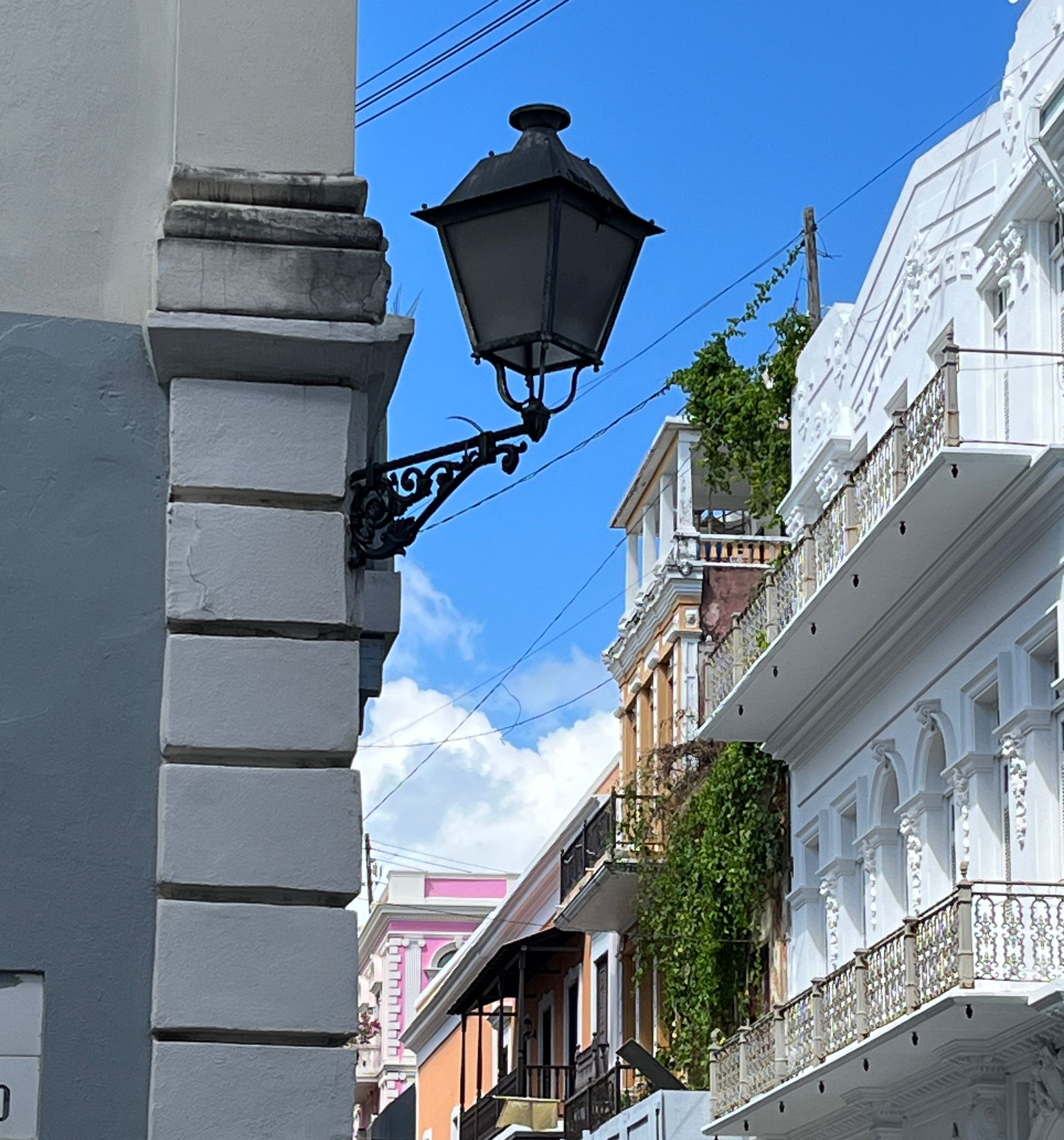
Our first and only full day in Puerto Rico was spent exploring Old San Juan. After breakfast at the Sheraton and a quick look around the hotel's fitness center, we took advantage of the complimentary shuttle into Old San Juan to the Plaza Colon, which is the free Shuttle dropoff and pickup point, though the location varies just a little on the same street if trolley tours are in the way. We walked to Plaza Arturo Somohano (downhill and past the pillar to Christopher Columbus in the center of the square) to meet our guide near Starbucks. We would find our guide had a PhD and we were the only guests for this tour – so we started right away through the historic streets and plazas.


We visited Plaza Colón, with its monument to Christopher Columbus, and continued along the colorful buildings along Calle de la Luna. We learned about the Spanish approach to city design. Narrow streets and strategically placed breezeways helped channel air flow to provide cooling from the heat that would otherwise build and radiate. Our guide shared some interesting local observations, including the presence of cats throughout the islands, where they help keep rat populations under control and the history of the island.


City Defenses
Along the way, we learned about the strategic importance of San Juan's harbor, the city's defensive walls, and the centuries of competition between Spain and other European powers. We stopped as the Bastion de las Palmas, part of the defenses of the city walls.


La Forteleza
Further along, we passed the street leading to La Fortaleza, the Governor's residence, behind a I heart PR sign and Hotel El Convento, a former convent that has been converted into a hotel. We also visited the Cathedral Basilica Menor de San Juan Bautista, where the tomb of Juan Ponce de León, the Spanish explorer and first governor of Puerto Rico, is located.


City Gates
We followed the tree-lined Caleta de San Juan down through the Puerta de San Juan.


Then we returned up to the top of the walls to the stop at the Plazuela La Rogativa, atop the walls, with a view of La Fortaleza and the harbor.

Following the road toward the Castillo San Felipe del Morro, better known as El Morro, we passed the colorful College of the Arts and the giant field, which was really the field of fire for the cannons of El Morro.
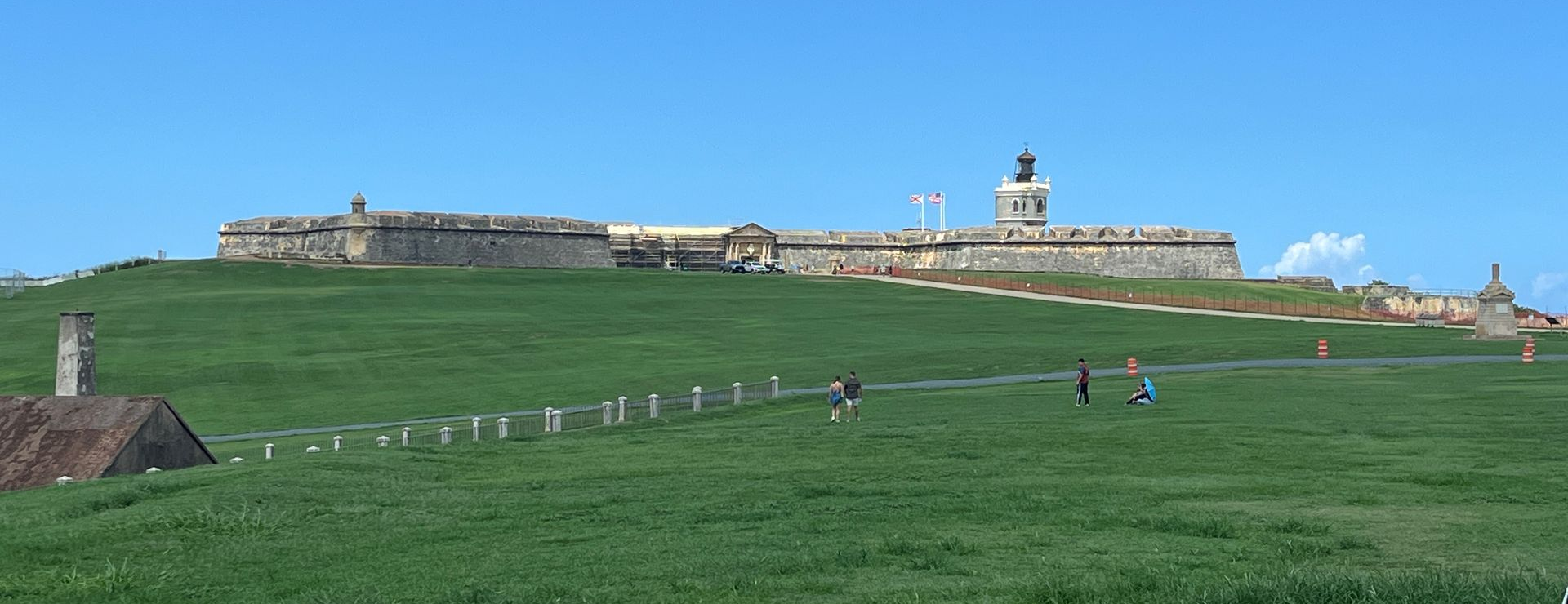


El Morro
The vast effort to build El Morro and the surrounding fortifications shows how important Puerto Rico was to Spain's position in the Caribbean. Construction of El Morro began in 1539, and the defenses expanded for centuries. El Morro, Castillo San Cristóbal and the city walls protected San Juan by land and sea, and these were tested when Dutch forces attacked San Juan in 1625 and failed to capture El Morro after a 21-day siege but still burned the city before leaving. The Spanish continued strengthening the city's defenses.


Anita Gelato
Before heading back, we stopped at Anita Gelato by the street toward the I heart PR billboard in front of la Forteleza, for… gelato. The small cup turned out to be anything but small, with a generously piled serving that was melting. A good tip: eat quickly!


Plaza de Armas
We walked to the Plaza de Armas, the historic town square and home to San Juan's City Hall (Casa Alcaldía and found a Banco Popular ATM in the plaza. Note that searches for “ATM” on Apple maps did not return ant results. This was identified as "ATH" on local maps and the transaction fee was $6, then we continued moving, toward the shuttle pickup near Plaza Colón. The names and locations didn't always line up neatly with Apple Maps, and searches were very specific, not returning matches. Looking down the streets for green trees matched up with parks and Plazas as we retraced our steps, keeping toward higher ground with Castillo San Cristóbal looming over the plaza and eventually visible as our landmark. We caught the shuttle

Back at the hotel, we had a cheeseburger and a fish taco for dinner at the rooftop pool bar with a view of the Convention Center. The bar closed earlier than we expected because we were not the high season – which is more toward January as a peak, so we had to keep an eye on the time.
Day 3 - All Aboard! Royal Caribbean's Rhapsody of the Seas
Our final morning in San Juan began with breakfast at the Sheraton's restaurant and had another good experience with the hotel's friendly service, ordering from the menu rather than choosing the buffet again. Before leaving, we took a few more photographs around the hotel, the rooftop infinity pool, the Convention Center, and the surrounding area. After two nights in San Juan, it was time to leave to board the ship.
The hotel called a taxi for us to the cruise terminal and in less than 10 minutes we were dropping our bags and getting checked in through security. Leaving more time is suggested – the day before it took 30 minutes to get a cab. Once aboard the Rhapsody of the Seas, we started getting acquainted with the ship, including its central atrium, dining rooms, lounges, pools, fitness facilities, and entertainment areas.
Our cabin was on Deck 4, about 50 feet down the hallway from the entrance to the Central Atrium. When you first board, these are unlocked and your keys are in the clip for the room next to the door. Despite being close to the activity, music, and performances in the Centrum, the cabin was surprisingly quiet. That was a welcome feature throughout the cruise.


Then we explored the ship. The main dining room was on Deck 4, where we had our assigned dinner seating. Dinner was usually at 5:00 PM, followed by the nightly entertainment. For breakfast and lunch, we generally went to the Windjammer Café buffet on Deck 9, forward on the ship. We ate with another couple from Missouri nearly every night and once we shared a tour with another couple from San Antonio, we found we were usually on the same excursions, and they joined our table as well. It’s more fun traveling with friends, and it was our privilege to share the time.
The fitness center on Deck 10 aft was accessible through the Spa on Deck 9 and up a flight of stairs, or by walking outside past the outdoor track also on Deck 10. The adults-only pool and seating area were aft on Deck 9, away from the activity around the main pool.


As the ship departed San Juan, we had a view of Old San Juan from the water. We sailed past La Fortaleza, the colorful College of the Arts, and the walls of El Morro. It was a different perspective from the walking tour we had taken the day before. As we left the harbor and headed out to sea, the moon rose over El Morro and Old San Juan.


The cruise had occasional theme nights, but dressing for them was optional. We generally dressed appropriately without making a production of it. Dinner was followed by the first evening's entertainment. The show opened with a short ballroom dance performance and continued with Max and Olga, an acrobatic couple whose strength, balance, and coordination made for an impressive performance. Their act was a highlight, and they held the audience’s attention throughout. To round out the evening, the Central Atrium hosted a balloon drop.

Later, I went out on deck watching the moon shining across the open water as the ship sailed toward Tortola. We chose island-wide tours rather than one or two attractions to see more of each island, including its communities, scenery, and historic sites. The first tour would be in Tortola the following day. And with that, it was time to sleep.
Day 4 - Tortola, British Virgin Islands: Island Roads, Coastal Views & Caribbean History

Our first port of call was in Road Town on Tortola, the largest of the British Virgin Islands. We docked in Road Town, where we had arranged an island-wide van tour to see more than just the area around the cruise port.
We returned from breakfast to find a little surprise in the cabin. Guess we all know about the elephant in the room - in this case, it was a towel elephant wearing Mike's glasses. Then we headed off the ship and walked through the shops that were open in the port before our tour. Being Sunday, many of the shops were still closed early in the morning. We eventually found our way to de Nils, and bought some white clothing: a shirt, skirt, and dress.
Next, we met our guide for the island van tour. As a British territory, Tortola drives on the left, although the narrow roads, with steep hills, sharp curves, and rapid elevation changes and lack of painted lane markings made staying in your lane a quaint suggestion.


St. Philip's Anglican Church
Our first major stop was St. Philip's Anglican Church, built by the island's freed slaves. The church is a reminder of each island’s shift from slavery to freedom, and indentured servitude and even serfdom in this transition and gratitude to GOD.

We crossed the Queen Elizabeth II Bridge to neighboring Beef Island, where cattle were previously raised, and now is the home of the island’s airport. The bridge view is sublime with a house standing opposite giant hills.

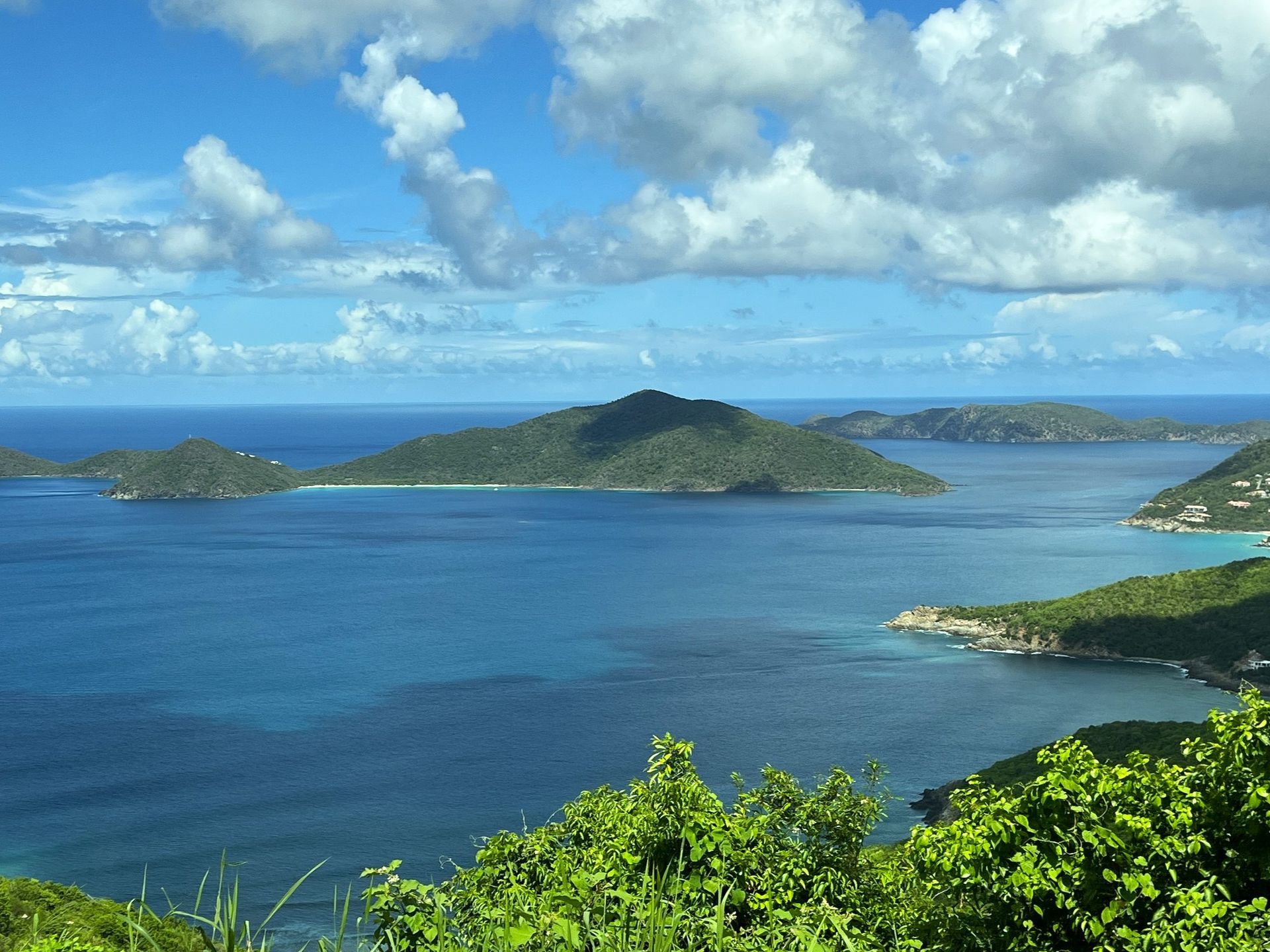
Ridge Road Overlooks
The scenery became especially impressive as we reached the overlooks along Ridge Road. This included a pause for the Josiah's Bay Pond overlook, and a full stop to view Guana Island and White Bay, with the Caribbean coastline stretching out below us. A little rum punch was available while we took in the view and captured some photographs.
British Virgin Islands Nearby
Off the coast of Tortola are other islands in the British Virgin Islands – such as Jost Van Dyke. The surrounding islands are a continual reminder that the islands are not only the main island tourists visit, but that sailors and ships regularly pass.
Churches
Along the way, we passed Mary Star of the Sea Catholic Church. Unfortunately, we missed getting a photograph of its beautiful open-air design during our Sunday visit. Religious life is important in the Caribbean with deep Catholic historical roots, and prominent Baptist and Seventh-day Adventist congregations and well-attended services.


Cane Garden Bay & Callwood Rum Distillery
Tortola’s western side off picturesque Cane Garden Bay holds Callwood Rum Distillery, located in a historic building and known for its traditional rum production stretching back around 400 years.


Road Town Overlook and Fahie Hill murals
Our tour also took us through Road Town, where we stopped at scenic overlooks offering different views of the harbor. The Fahie Hill murals added another stop to the tour, with colorful artwork along the hillside.
Sunset and Theater Show
After a full day touring the scenery of the island, we returned to the Rhapsody of the Seas. Back aboard, we enjoyed the sunset over the Caribbean before the evening's entertainment – the ballroom-themed show, Ballroom Fever.
Day 5 - Sint Maarten & Saint Martin: One Island, Two Countries

Dutch Sint Maarten and French Saint Martin, two separate countries, share a single island peacefully today, but for over a century after Columbus claimed it for Spain in 1493, Dutch, Spanish, French, and other European interests struggled for control. Spain occupied the island for a time before the Dutch and French reached an agreement in 1648 known as the Treaty of Concordia to divide the island under both powers – the longest lasting treaty on earth as of today.
There are no traditional border checkpoints between the two sides, but each has its own culture, character, and attractions. Under the Kingdom of the Netherlands, the Dutch side is known for its casinos and a more permissive approach to entertainment and tourism, while the French side has a distinctly more reserved atmosphere as it is as much France and EU as any other part of France.


Sint Maarten – The Dutch Side
We began the morning with a sunrise over Sint Maarten before docking in Philipsburg, capitol of the Dutch side. On the way to meet the tour, we passed a statue of Pieter Stuyvesant, the last leader of Dutch New Netherland (which included New York). Stuyvesant was unsuccessful but valiant in this expedition and surrendered the Dutch colony to the British in 1664. Then we walked on to check in with our tour group in the fenced EDC parking lot at the end of the street past the taxi areas and after the group assembled, off we went to explore.

Amsterdam Cheese and Liquor
Philipsburg had a distinctly Dutch Caribbean atmosphere, with its waterfront boardwalk, colorful shopping streets, and busy cruise port. We stopped at the Amsterdam Cheese and Liquor Store, known for Dutch Gouda cheese and souvenirs.


Philipsburg Boardwalk and Beach
Then we walked between buildings to reach the boardwalk running along the beach, with views of the lighthouse and the ship and a few colorful buildings. One bar boasted of being rebuilt with driftwood after a devastating Hurricane. This is common to reclaim damaged materials throughout the Caribbean, so building with stone is generally preferred but roof replacement still might take some time.


Sint Maarten Courthouse & Old Street (Shopping)
Just a street of the boardwalk was the Sint Maarten Courthouse. Unlike some historic-looking buildings that turn out to be museums or commemorative structures, this was the actual courthouse - to our surprise. We also explored a few of the smaller shopping streets, on the way back to the meeting point at the Amsterdam Cheese and Liquor Store, which offered a different view of the town beyond the busy waterfront and prime commercial spaces and took us past the Casino.
Saint Martin - The French Side
Crossing to the French side, we noticed a change in the landscape. Saint Martin appeared drier and rockier in places, with a different character from the Dutch side.


Moses Walk
One stop was Moses Walk, a shallow-water crossing over a raised sandbar leading toward a small rocky island. In pictures when the tide is in, it shows up as a lighter green path underwater (like the top right photo), but under the right tidal conditions, visitors can walk out through ankle-deep water. Unfortunately, the water was around three feet at the wave crests when we visited. It was still interesting to see, but walking all the way out was out of the question. Opposite the beach here, the more desert-like climate can be seen in the bare rocks.


Iguana Spot
We also stopped at the Iguana Spot along Rue de Coralita in Quartier d'Orléans. This roadside attraction gives visitors an opportunity to feed leaves to the local iguanas. It was certainly a different kind of wildlife encounter.

Salt Ponds
Our tour continued toward Salines d'Orient, the historic salt ponds that were once an important part of the island's economy. The salt industry has largely disappeared, and the ponds are no longer maintained as they once were.


Orient Beach, Bikini Beach Bar, Sand
Nearby was Orient Beach, with its white sand and turquoise water. We stopped at Bikini Beach Bar and Restaurant for refreshments and to enjoy the view.


Marigot - French Fort Louis
We continued to Marigot, the principal town on the French side, and stopped beneath the hilltop Fort Louis overlooking the town. The fort is a reminder of the island's strategic importance and its history of European competition. Lady Liberty on a turnabout is celebrated on the island.
For lunch, we stopped at Chez Fernand - La French Bakery - and enjoyed pizza. Marigot had a distinctly French Caribbean atmosphere, with its shops, bakeries, and waterfront.

Monument to Friendship
As we passed back into Dutch Sint Maarten, a monument commemorates the 320th anniversary of friendship between the Dutch and French communities on the island as "320 ans d'amitié,". While sharing the island and friendliness, both sides maintain their unique identities.


Maho Beach – Low Beach Landings
Tourists flock to Maho Beach at the end of the runway for the Princess Juliana International Airport to experience large aircraft flying down to around 45 feet over Maho Beach before touching down on the runway. We just caught one from JetBlue on final approach close to the beach and road. It's just not something you see every day.
We got a table at the famous Sunset Bar & Grill overlooking the beach, ordered refreshments, and waited for the aircraft. The bar even maintains a flight-arrival board so visitors can anticipate the next landing. However, we had already seen the largest aircraft scheduled for a while and watched a propeller aircraft cross low but would have had to wait longer than we had to be back on board by 4:3PM. The larger jets were scheduled later.


Indigo Bay
Our final stops included Indigo Bay, where we enjoyed another scenic overlook and saw the statue of William Henry Bell, also known as “man in a chair”. It was another opportunity to take in the island's coastline and a quirky piece of art before returning toward the cruise port.


Back aboard, the evening entertainment featured Xplosion, an Argentine dance and percussion performance.
Day 6 - Antigua: Exploring from St. John's

Antigua was our next port of call. We docked at St. John's Harbor, the island's capital. After going ashore, we met our guide near Rumrunners by the Sea for an island tour and had some time, so we made a loop around the block and saw some interesting sights you just don’t see in the US.


When we returned for the tour, our group was small: the two of us and a British couple. That made for a relaxed outing, with plenty of opportunity to talk and compare experiences along the way.

Cricket
The conversation took an entertaining turn when we passed Sir Vivian Richards Stadium, the cricket grounds built in 2007. Our British companions and our Guide quickly found themselves discussing (instigating a friendly argument about) Antigua's cricket legend and how he compared with great players from elsewhere. It was a fitting introduction to an island with strong British connections.


Devil's Bridge: The End of the Island
Our first major stop was Devil's Bridge National Park. The Atlantic Ocean has carved out a broad cavern beneath the coastal rock and pushed upwards to cut a slot behind it. This left a 25-30-foot-long natural stone bridge that is suspended about 4 feet over the waves flowing under it and crashing into the back of the cavern. This is not dramatic with the calm waters that day, but in a storm, it must be amazing when the waves channeled into the cavern crash into the cavern’s back wall and sends a geyser upwards through the slot.
Local tradition holds that desperate enslaved people jumped from the rocks into the sea on the easternmost point of the island facing Africa rather than remain in captivity.


Nelson's Dockyard - UNESCO Site
Our next stop was Nelson's Dockyard, one of Antigua's most important historic sites and part of the UNESCO-listed Nelson's Dockyard National Park. The dockyard is named after Admiral Horatio Nelson, who served here earlier in his naval career before becoming famous for his victory at the Battle of Trafalgar against a French fleet. The “Crossing of the T”.
The grounds reflect the character of a naval base. Some buildings are present in structure if not roof, but the historic naval buildings, cannons, the wharf, and harbor, along with the boathouse, are well preserved. We also visited the Naval Officers' and Clerks' House Museum. Smaller details, including a traditional phone booth and a sundial show the site is still used – just not for its’ original purposes – such as the three capstans to pull ships up on their sides to scrap off barnacles. It’s a glimpse into history.

The dockyard sits within a sheltered harbor surrounded by fortified hills to guard against land or sea attacks. Across the harbor is Clarence House, a vacation home for royalty.


Shirley Heights: History with a View
From the dockyard, we drove toward Shirley Heights Lookout, part of the defensive fortifications, stopping at the Blockhouse overlook, where you can see the famous St. James's Club and its’ green roofs, Eric Clapton's house and rental property, and the rugged coastline.


At Shirley Heights Lookout, and artillery position looming over the Fort Berkeley, positioned at the English Harbor entrance and Nelson's Dockyard. We stopped and ate a lunch consisting of fish and chips, with the dressing served in an old tequila bottle- - very British fare. With only four people on the tour and not interested much in the beaches here, we had time to relax and enjoy the meal and talk about life.


Churches and a Return to St. John's
As the tour continued, we passed several churches reflecting Antigua's religious and architectural heritage. Among them were St. Paul's Parish Church, a stone church; St. Barnabas Anglican Church, a coral-colored church; and St. John's Cathedral. Their different designs and settings gave us another look at the island's communities.


We eventually returned to St. John's, where we had another opportunity to see the town and harbor before heading back to the ship.


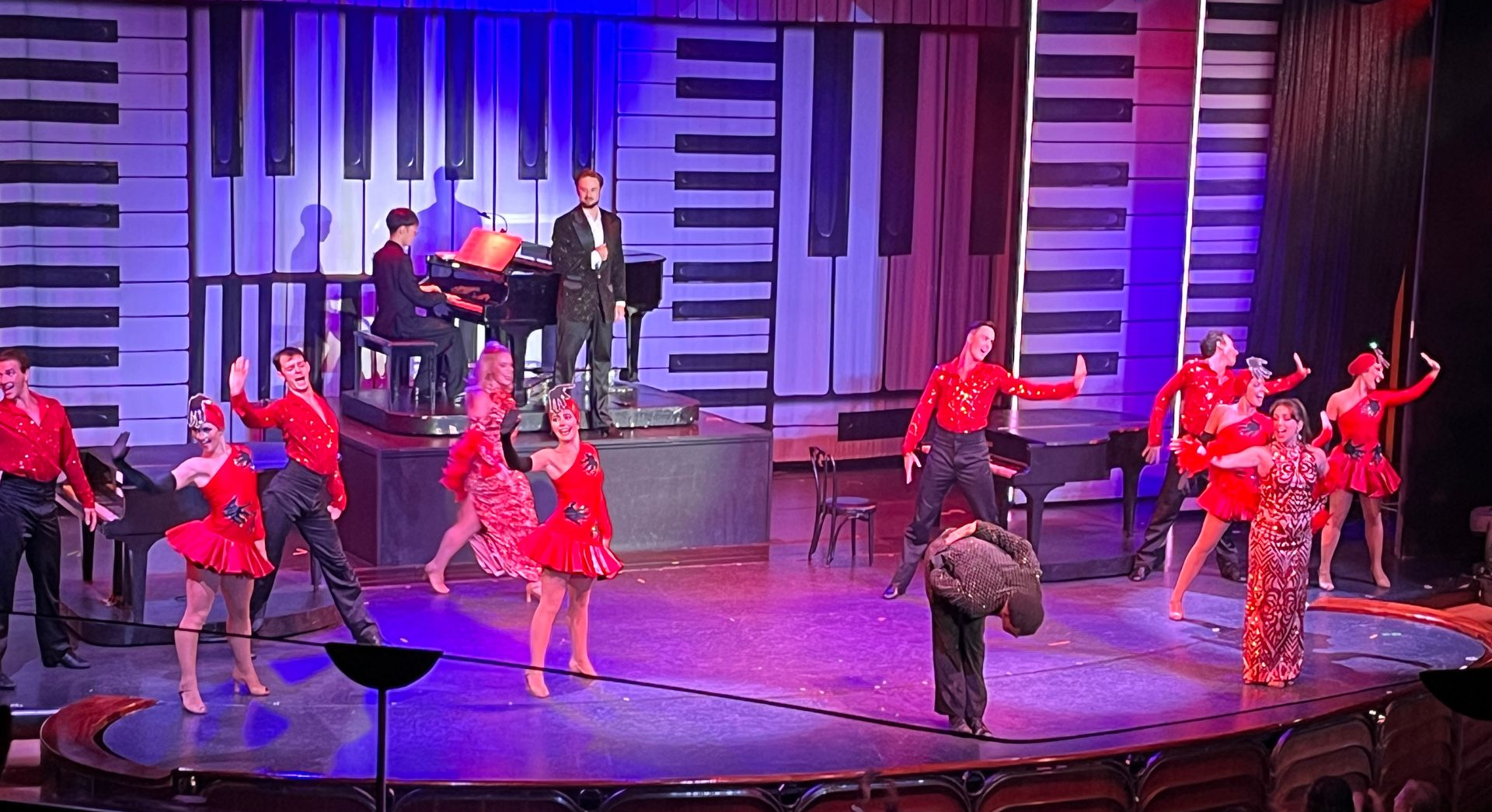
Back aboard the Rhapsody of the Seas by 4:30PM, we had dinner and then attended the evening's theater performance featuring an orchestra and dance.
Day 7 - St. Kitts: A Caribbean Island Tour

We docked this morning in Basseterre, the capital of St. Kitts. Before setting out, we encountered a street entertainer with two monkeys named Chip and Dale. For $5, we got a picture with the pair.
Then we began a six-hour island tour. Our Tour Guide (and Driver) was on his final day before retirement, so we had a seasoned guide.


Basseterre, Interior Hills, Coastal Plains, Railroad
We started with a look around Basseterre, including the town square, cathedral, and cricket stadium. We did not stop here, so there are few pictures. Outside of Basseterre, the island is heavily forested (or jungle) on the interior and up the hills while the exterior is flatter with fields and towns dotting the coastline. We also saw remnants of the island's old railway. A railroad once circled the island, serving the sugar industry and connecting communities. Although the trains are gone, sections of track, old roadbeds, and crossing gates remain visible in places.


Wingfield Estate, Sugarcane, Sugar, Molasses, and Rum
St. Kitts has a long history of sugar production and that is where we will start. At the Old Road Rum Company at Wingfield Estate, we explored the remains of a sugar and rum operation. The estate's machinery and buildings show how important sugarcane production was to the Caribbean economy.
Sugarcane was first crushed in the mill to extract its juice. The juice was clarified using steam-heated equipment, allowing impurities to rise so they could be skimmed away. It then went through several boiling stages in copper kettles as the liquid became more concentrated. As the concentrated cane juice cooled, the sugar crystals must be broken up, leaving liquid molasses as a byproduct.
The sugar and molasses mix is transferred into barrels in the curing area, where more molasses drains away. That molasses goes to the mash house, mixed and fermented with water and yeast, and distilled into rum.
The stages of turning sugarcane into products can’t be skipped and shaped the Caribbean islands’ economies. The estate sits beside a network of rainforest trails. The surrounding vegetation is dense and despite having no rain recently, bug spray is a really good idea if you plan to go near the trails.


Romney Manor: Gardens, History, and a Giant Tree
Our next stop was Romney Manor. The estate has a complicated history, as do many properties associated with European colonial expansion in the Caribbean. The land was connected to the Carib people’s Chief before English arrival, and the island's history includes violent conflict between Indigenous communities and European settlers.
The property later came into the hands of Samuel Jefferson, the great, great, great grandfather of 3rd U.S. President Thomas Jefferson. It was sold after a short time to the Earl of Romney, giving the estate the name it carries today.
The grounds were a welcome change of pace, with gardens, flowering Flamboyant Tress, A central fountain, and raised deck with shaded seating. The broad canopy and enormous trunk of a giant saman tree, around 400 years old dominates the downslope.
There were also a few unexpected photo opportunities. The restroom area beside the gift and clothing shop was distinctive enough that everyone seemed interested in taking pictures of it! From the terrace, we could see across the island's forested interior.
Brimstone Hill Fortress: A Fortress Above the Caribbean
A major highlight of the day was Brimstone Hill Fortress National Park, a large complex of defensive works built high above Sandy Point Town on the coast. The British fortified the site to protect their interests on the island, particularly against French military activity in the region.


The access road climbs around the massive volcanic rock formation, with tight curves, steep grades, and narrow gates barely wide enough for the bus to pass. The effort was worth it. From the fortress, we could look down toward Sandy Point Town and out over the surrounding coastline. The complex includes several defensive positions at different elevations, with the Citadel at Fort George occupying the highest point.
The fortifications were designed as an integrated defensive system. The Lower Prince of Wales Bastion and the Magazine Bastion sit below the Citadel, with the magazine serving as a storage area for gunpowder. Each position helped defend the approach to the fortress and the surrounding island. After a brief movie on the site, we took a very short tour of the upper citadel with an outstanding local guide.

The cannons had an estimated range of about two miles, allowing defenders to engage ships well off the coast half a mile away. We also saw markings used to identify artillery that had passed inspection and been approved for military service with an arrow marking.
The British eventually abandoned Brimstone Hill in 1853–1854 and it fell into disrepair from foundation settling before repair. The surviving walls, bastions, buildings, and artillery positions give visitors a sense of the scale of the engineering and the strategic importance of the site.

Lookouts, Beaches, and Volcanic Coastline
After leaving the fortress, we continued to Brews Lookout, where the views included St. Eustatius and Dieppe Bay. From these elevated viewpoints, the island's steep green hillsides dropped toward the coast.


Volcanic Sand and Rock Beaches
We also saw Sandy Bay's dark volcanic sand and continued along the coast to Blackrock volcanic runoff in the surf zone, where volcanic boulders form a rugged shoreline. This is not the typical soft, white-sand Caribbean beach, instead the surf crashes hard into large black rocks, showing the island's volcanic origins and the sea’s power.

Frigate Bay and The Strip
Our tour eventually reached Frigate Bay, the island's principal resort and tourist area. The Royal St. Kitts Golf Club and the Marriott's St. Kitts Beach Resort are among the prominent features of this part of the island.

Timothy Hill Overlook to Frigate Bay
From Timothy Hill, the views were particularly impressive. One direction offered a panoramic look across the resort area and Frigate Bay, while the other revealed a series of green ridgelines stretching into the distance.

We returned to the port, passed through The Strip, the stretch of beach with many bars and clubs serving visitors and locals. After six hours of exploring, we returned to Basseterre and the Rhapsody of the Seas. We needed a rest and had work to do.
Day 8 - St. Croix: Discovering the U.S. Virgin Islands

We docked at the port of Frederiksted on St. Croix in the U.S. Virgin Islands. Fort Frederik, a low red fort, guards the harbor at the base of the pier. From there, we set on a daylong tour to explore more of the island, including Christiansted, its historic Danish architecture, coastal overlooks, and reminders of the sugar and rum industries that once dominated the economy.
St. Croix has unique in the United States, as its history is rooted in European colonial rule including a long Danish period rather than British as our experience was. One of the first things visitors notice is that traffic drives on the left as the Danes required it when the United States bought St. Croix in 1917 for $25M. Denmark now drives on the right, but we honor that treaty, nonetheless.
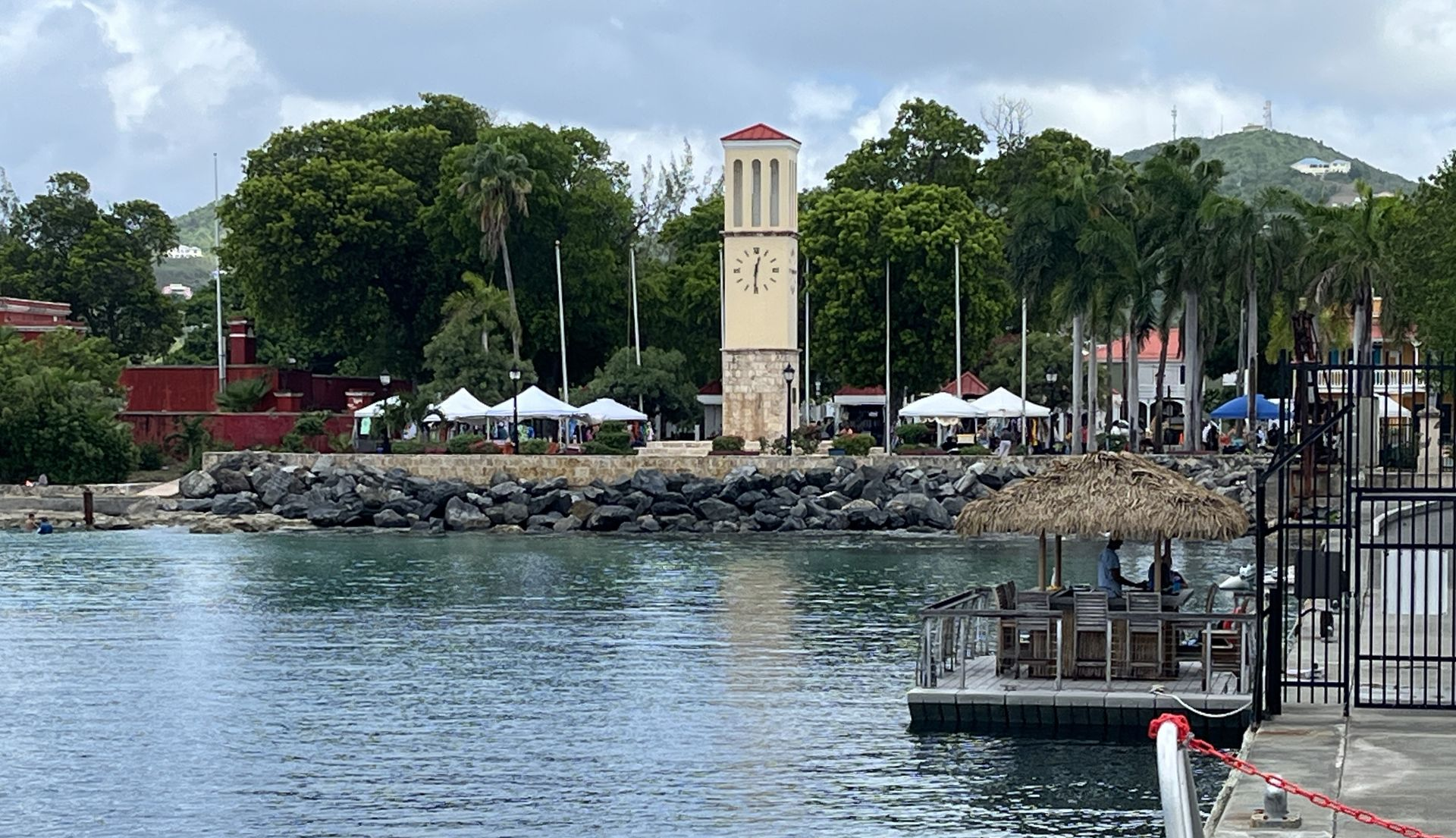
Frederiksted, Red Fort & Clock Tower
The clock tower is another prominent feature, although our guide explained that main clock towers around the island were stopped - don’t use them because they are on island time


Baobab Tree
The tour departed immediately for Christiansted, stopping at a wide baobab tree sourced from Africa. Its massive trunk stood out from the surrounding vegetation and is locally infamous for as the response to a rebellion and for being used to hide.

Christiansted Harbor Overlook
We also stopped at an overlook above Christiansted Harbor. From there, the town and waterfront were spread out below us, giving us a preview of the historic district we would soon explore.


The Buccaneer Resort
Another major property along the route was The Buccaneer Resort. The main drive and grounds were impressive, with views toward Altona Lagoon and Beauregard Bay. Its setting overlooking the water showed another side of St. Croix: an established resort destination alongside its colonial and industrial history.
Christiansted: Danish Heritage and Waterfront Life
Christiansted was one of the highlights of the day. Its historic harbor, government buildings, churches, and waterfront give the town a distinctly different feel from the other Caribbean ports we visited.

Old Danish Customs House
At the harbor, we saw Fort Christiansvaern, the yellow fort overlooking the waterfront. Nearby were the Old Danish Customs House and Government House, reminders of the island's former role as a Danish colonial center.

Government House
Government House also brought an American historical connection into the story. Alexander Hamilton lived in Christiansted from 1765 to 1773, before moving to the American colonies. It was an interesting connection between this Caribbean island and the early history of the United States.


Gallows Bay Harbor, Boardwalk
The waterfront around Gallows Bay and the boardwalk offered a more relaxed side of town, with cafés, bars, hotels, and places to sit and enjoy the harbor. We also saw the Cruzan Rum export operation; another reminder of how closely sugarcane and rum production are tied to St. Croix's history.

Protestant Cay
Out in the harbor is Protestant Cay, a small island with its own history. Our guide explained that Protestants were buried there during a period when burial on the main island was restricted to Catholics. It was a striking example of how religious divisions once shaped everyday life, even in something as fundamental as where people could be buried.


Christiansted Churches
The churches around Christiansted added to the historical picture. Among the buildings we saw were Lord God of Sabaoth Lutheran Church and another church with a prominent steeple. Their architecture reflected the island's varied European influences and religious traditions.
Our guide warned that ATMs in the area were frequently out of service. Between the clocks that often showed the wrong time and the unreliable ATMs, we heard a few practical reminders that visiting an island and living there are two different experiences.
Sugar, Rum, and Industry
Sugarcane was once the foundation of St. Croix's export economy. Like several of the islands we had visited, St. Croix developed an extensive sugar industry, with plantations and processing operations shaping both its economy and landscape.


Captain Morgan Rum Distillery, Limetree Bay Refinery
The island's rum heritage continues today. We passed the Captain Morgan Rum Distillery, another reminder that sugarcane's legacy did not disappear when the old plantation economy changed. We also saw the large storage facilities at Limetree Bay, evidence of the island's more modern industrial history. This refinery is expected to come online next year (2027).
More Island History Along the Way
Our tour also included references to the island's earlier European exploration. Christopher Columbus reached the Virgin Islands during his second voyage in 1493, and the Salt River area on St. Croix is associated with that early encounter. The island's history stretches well beyond the towns and buildings we saw that day.


Back to Frederiksted and the Ship
We returned to Frederiksted and did a little shopping for mementos. After dinner that evening, we went to our final Theater show for Pure Country, a country-themed dance performance.
Day 9 - A Day at Sea: Relaxing, Celebrating, and Getting Ready to Go Home
After several days of exploring Caribbean islands, Day 9 gave us a chance to enjoy the ship without having to make a port call or meet a tour schedule. The day aboard the Rhapsody of the Seas, taking part in activities, visiting with friends, and getting ready to disembark in San Juan the following morning.
A Tribute to Veterans
One of the day's more meaningful events was a Veterans' Tribute held in the ship's Central Atrium. It provided an opportunity to recognize those who served rousing renditions of the National Anthem, and their Service Songs.
Trivia, Dancing, and a Little Karaoke
Along with the dancing events, Rose hosted the trivia events, making them fun and giving everyone a reason to participate. One important fact we took away from the day: everyone who attended now knows that the capital of Brazil is Brasília!
We also danced, played more trivia, and enjoyed the activities around the ship. Karaoke added another highlight, with one of us taking the microphone to sing Frank Sinatra's "My Way." It was a good way to spend one of our last evenings aboard and complemented the Bon Jovi anthem Livin on a Prayer performed as one of four guys in the Central Atrium.

New Friends
We shared many dinners with a couple from Missouri with a recap of the day – they went to the beaches and we took the tours. We also got to know some new friends from San Antonio, Texas, who had joined us for dinners after a few days abord. San Antonio isn't exactly next door, but it's reasonably close by Texas standards.
An Unusual Route Back to San Juan
Although this was designated a day at sea, the ship's route was interesting. With the islands relatively close together, the Rhapsody of the Seas did a loop through the Caribbean before heading back toward San Juan overnight.
Getting Ready to Disembark
We prepared to leave the ship, packing bags placing luggage outside the cabin for transfer to the dock in the morning.
Day 10 - Disembarkation & The Journey Home
Day 10 brought us back to disembark in San Juan. We ate breakfast in the Main Dining Room on Deck 4.
Disembarkation
Disembarkation was organized by luggage group number, and we left the ship in Group 1. We collected our bags and exited the cruise terminal.
Royal Caribbean Airport Transfer
When you exit the terminal, if you have transfers from Royal Caribbean, go straight forward – there is a blue check-in stand and the buses for the transfer are just beyond that. Tip: People crowd around this blue stand and block your visibility to it – it’s there before you reach the buses.
The ride to the airport was brief. Royal Caribbean's buses dropped passengers at the far end of the terminal area, so we had to walk outside to reach the terminal entrances.
The San Juan Airport Entrance
When you arrive, Royal Caribbean transfer buses must park in a spot past all the Terminal numbers, and you must walk outside to get to Terminal 3 – which is the closest. San Juan's airport has three numbered doors to enter the mail hall. Terminal (Doors) 1, 2, and 3 all enter the SAME hall (2026). These are NOT separate, isolated terminals. Use whichever entrance is convenient.
Department of Agriculture Inspection
Before airline check-in and security, take your checked luggage through the Department of Agriculture inspection. The screening area is near the glass in the middle of the hall. It is part of the airport process, so allow time for it.
Security Delay
When we arrived, we were 6 hours ahead of the departure for our nonstop flight to DFW at 3:35PM but security only allows bag check-in and entry 4 hours or less before a flight. So, we waited.
Making the Most of a Long Pre-Security Airport Wait
For about 45 minutes we sat on luggage – there are NO seats in the terminal hall. After a while, we settled into a café and took our time with refreshments: tea, coffee, a muffin, a sandwich, and eventually a few more things. Dining choices were limited, so finding a comfortable place to wait was better than sitting around on luggage.
Once the four-hour window arrived, and very well fed, we checked our bags and cleared security and entered the duty-free shopping area.
Finding Your Gates
Everyone enters the Duty-Free shop after clearing security.
A&B-Gates and the best food options are to the right.
C-Gates are straight forward from security and to a corridor to the left (during construction). The sign for the C-Gates is 15-20 feet down the corridor and around the corner, so it is very easy to miss. Mike missed it in the first pass, and it felt like a Bermuda Triangle moment – I could see the C gate numbers outside by the planes but didn’t see the corridor leading to them.
One Last Taste of Puerto Rico
In the A and B gate area, we found Margaritaville, where we had a Cheeseburger in Paradise and chicken salad. It was our last meal in Puerto Rico.
We also had one last opportunity to shop for souvenirs. The airport stores offered a chance to pick up refrigerator magnets and locally branded gifts that we hadn't really found elsewhere—or hadn't thought to look for during the trip.
Our departure gate changed twice while we were waiting, so check the airport departure screens again as boarding time approaches or monitor for updates if you are receiving updates. The gate listed earlier may not be the one you eventually use.
Homeward Bound
Eventually, we boarded our American Airlines flight and headed back to Dallas/Fort Worth.
Bon Voyage!